

Michael Horbal is the founder of RiskQuoter.com, an independent life insurance agency specializing in high-risk applicants. His goal is to help consumers find the best life insurance rates possible by matching them with the right insurer.
Thinking about AARP life insurance? Before you apply, it’s worth asking: Is it actually a good deal—or just easy to get?
In this review, we compare AARP to other life insurance companies, evaluating its competitiveness for both healthy individuals and those with high-risk medical conditions.
AARP Life Insurance – Easy Approval, but at What Cost?
AARP teams up with New York Life to offer final expense life insurance policies designed for members. The marketing is hard to miss: No medical exams, easy application, lifetime coverage.
But convenience often comes with a price. And in the case of AARP life insurance, that price can be much higher than you’d expect, especially if you’re relatively healthy.
In this review, I’ll explain the four AARP life insurance policies, their costs, and when it might be a better option to consider alternative life insurers.
AARP Life Insurance – A Quick Overview
The AARP Life Insurance Program from New York Life offers no-medical-exam policies for AARP members. Policies are easy to apply for but come with higher premiums and limited coverage.
Key Selling Point: Easy approval—no medical exam required for any plan.
Key Drawback: Premiums are higher, and coverage amounts are limited.
AARP offers four types of life insurance:
- Level Benefit Term Life Insurance – Up to $150,000
- Permanent Life Insurance – Up to $100,000
- Permanent Life with Living Benefits – Up to $100,000
- Guaranteed Acceptance Life Insurance – Up to $30,000
Now, let’s dive into the details.
AARP Term Life Insurance: Why the Price Doesn’t Hold Up
AARP markets its term policy as easy and fast. It is, but at the cost of value.
Features of this term life insurance policy include:
- Up to $150,000 in coverage
- No exam, just health questions
- Premiums go up every 5 years
- Coverage ends at age 80.
- Pros:
- Simple online application
- Fast approval
- Cons:
- Premiums increase every 5 years
- Coverage ends at age 80
- Healthy people are better off with underwritten policies.
AARP Term Life Insurance Rates
How do AARP term life insurance rates compare to other companies? AARP term life insurance rates are terrible when compared to other companies.
Remember that AARP rates increase every 5 years, whereas other companies’ rates remain level for the term duration chosen.
Sample rates, male age 57.

Monthly premium comparison of AARP vs. other companies.
| Coverage | AARP | Competitor | Competitor Premium |
|---|---|---|---|
| $10,000 | $18 | N/A | Not available |
| $25,000 | $36 | Assurity | $14 |
| $50,000 | $65 | Assurity | $20 |
| $100,000 | $116 | Transamerica | $30 |
| $150,000 | $157 | Transamerica | $44 |
Key takeaway: AARP term life insurance rates are 2-3 times higher than underwritten options for the same applicant.
AARP Permanent Life Insurance: Easy, But Expensive
Some of the key features of this whole life insurance policy include:
- Up to $100,000 in coverage.
- No medical exam required.
- Level premiums for life
- The policy may build cash value.
- Pros:
- Lifetime coverage
- No further premiums needed after age 95
- Simple approval
- Cons:
- Limited cash value accumulation
- Premiums are expensive
- Healthy applicants would benefit from an underwritten policy.
This is a simplified-issue whole life insurance policy. If you are relatively healthy, better options will exist with underwritten whole life and universal life policies.
AARP Permanent Life Insurance Pricing
So, how does AARP compare to other companies?
Take a look at these rates for a 57-year-old male.

How do rates from our companies compare? Here are the prices for a 57-year-old male: whole life insurance with Mutual of Omaha, and universal life insurance with Pacific Life and Protective.
| Coverage | AARP | Competitor | Competitor Premium |
|---|---|---|---|
| $5,000 | $23 | Mutual of Omaha | $21 |
| $10,000 | $44 | Mutual of Omaha | $39 |
| $25,000 | $106 | Pacific Life | $58 – $64 |
| $50,000 | $199 | Pacific Life | $95 – $108 |
| $100,000 | $386 | Pacific Life | $136 – $176 |
If you have health issues, you may still qualify for a better rate on an underwritten policy. As you can see, it is worth considering other options, especially once the coverage amount exceeds $25,000.
AARP Life with Living Benefits: Is It Worth the Upgrade?
A policy that includes a rider such as living benefits for chronic illness may be worth considering. Features include:
- Whole life insurance with a 50% chronic illness payout option.
- No medical exam
- Premiums stop at age 95
- Cash value accumulates.
- Pros:
- Chronic illness benefit
- Lump sum living benefit
- Lifetime coverage
- Cons:
- Using the chronic care benefit cuts your death benefit in half.
- Medicaid eligibility may be affected if you use the living benefits
- Premiums are more expensive.
Living benefits are nice, but they come at a steep price.
Reality check: You’re paying extra for the rider. In most cases, a hybrid life/long-term care policy or fully underwritten coverage will offer more protection for your money.
AARP Guaranteed Acceptance Life Insurance: Only for Last Resort
This final expense policy requires no health questions. But like most guaranteed issue products, it comes with a 2-year waiting period for natural death.
Features:
- Coverage up to $30,000
- No exam, no medical questions
- Premiums stay level and stop by age 95
- Lifetime coverage.
- Cash value builds over time.
- Pros:
- Guaranteed acceptance
- You may borrow from the cash value
- Premiums stop at age 95
- Cons:
- Two-year waiting period for natural deaths.
- Premiums may exceed the death benefit over a long lifespan.
How do AARP Guaranteed Acceptance Rates Compare?
AARP recently announced lower rates for this policy, and the premiums are very competitive for coverage up to $15,000. Above that, there are better options.
Sample male rates, age 57
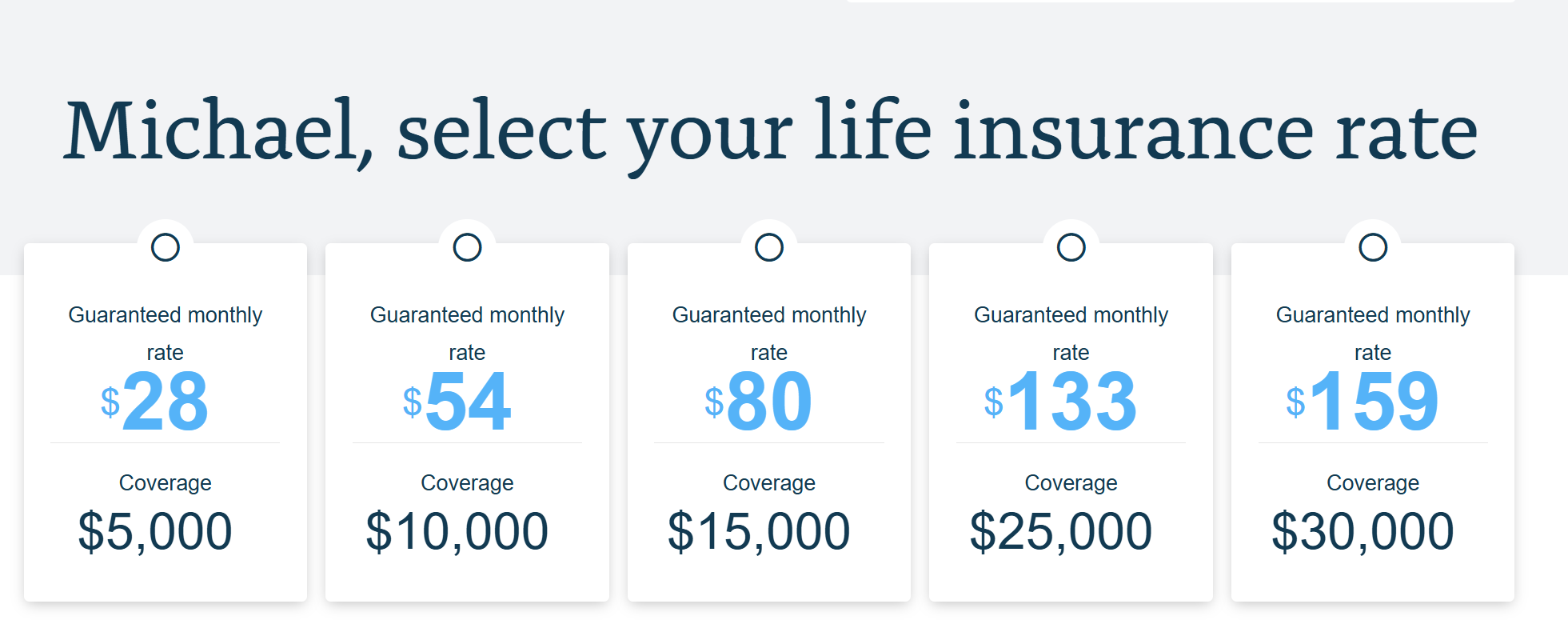
How do other companies compare?
| Coverage | AARP | Gerber | Guarantee Trust Life |
|---|---|---|---|
| $5,000 | $28 | $31 | $34 |
| $10,000 | $54 | $62 | $64 |
| $15,000 | $80 | $92 | $94 |
| $25,000 | $133 | $60 | $154 |
| $30,000 | $159 | $72 | $184 |
In the above example, AARP and Gerber are guaranteed acceptance with a 2-year graded benefit period. Pacific Life requires underwriting but provides an immediate death benefit.
Key takeaway: AARP’s guaranteed issue plan is only worth considering if you’ve been declined elsewhere.
Who Should Consider AARP Insurance?
AARP gives many people peace of mind, and the most important thing to do is to have life insurance.
From a price standpoint, the only AARP product worth considering is the guaranteed acceptance final expense insurance policy. Better deals are available for every other life insurance policy offered by AARP.
Contact us to ensure you receive the best available deal. We’ll show you all available options and let you compare them to those offered by AARP.
FAQ
It may be suitable for individuals with severe health conditions, but most healthy individuals can find better and cheaper coverage elsewhere.
The term life premiums increase every five years. Permanent and guaranteed acceptance premiums stay level.
High premiums, limited coverage amounts, and waiting periods (for some plans).
AARP’s policies are slightly better priced and offer more options, but are still overpriced for healthy individuals. Both should be considered only when fully underwritten policies are unavailable.
It doesn’t. AARP term life insurance rates are far more expensive than those of other companies. Additionally, AARP rates increase every 5 years.
Final Thoughts: Is AARP Life Insurance Worth It?
AARP makes life insurance easy, but not cheap for members. Most of their policies cost significantly more than underwritten alternatives.
If your health is decent, don’t settle for less.
Compare quotes from top-tier companies first. You might pay less and get more.